
Home › Advice › Signs you need a wheel alignment
A wheel alignment is one of the cheapest jobs on the workshop menu and one of the most overlooked, right up until it quietly chews out a set of tyres. Alignment is simply setting the angles of the wheels back to where the manufacturer intended, so the car tracks straight and the tyres wear evenly. Here is how to tell when yours has drifted.
The signs your alignment is out
- The car pulls to one side. Ease off the wheel on a straight, flat road and if it drifts left or right on its own, the alignment is a likely cause.
- The steering wheel sits crooked when you are driving dead straight. It should be centred. If the badge is off to one side, the toe is out.
- Tyres wearing on one edge. The inside or outside shoulder scrubbing away faster than the rest is the classic alignment signature, and it is money straight off the life of the tyre.
- Uneven or feathered tread, where the tread blocks feel like little ramps when you run your hand across them.
- Vague or wandering steering, where the car never quite settles and you are always making little corrections.
What knocks it out in the first place
Around here it is often the simple stuff. A solid hit on a pothole or a kerb, the corrugations and gravel on the roads west, or just the slow settling of suspension over time and kilometres. New tyres, a suspension repair, a lift kit or new steering components are all good moments to align, because the geometry has changed. A lot of people also book one in as cheap insurance whenever they fit a fresh set, so the new rubber is not wearing crooked from day one.
A rough guide to how often
- Every 10,000km or so, or once a year, as general maintenance.
- Whenever you fit new tyres, so they start life tracking true.
- After any solid kerb or pothole hit, or suspension and steering work.
- The moment you notice a pull or uneven wear, before it costs you a tyre.
Camber, toe and caster in plain english
The printout you get lists three main angles. You do not need to be a mechanic to follow them.
Toe
Look down at the wheels from above. Toe is whether the front edges point slightly in towards each other or slightly out. It is the biggest cause of rapid, even tyre wear when it is wrong, and it is what makes a steering wheel sit crooked. This is the one that matters most for tyre life.
Camber
Now look at the wheel from the front. Camber is the tilt, whether the top of the tyre leans in towards the car or out away from it. Too much either way wears one edge of the tyre and can make the car pull.
Caster
Caster is the angle of the steering axis seen from the side. It is what gives you straight line stability and self centring, the way the wheel returns after a corner. It does not wear tyres the way toe and camber do, but it affects how the car feels to steer.
Why the printout matters
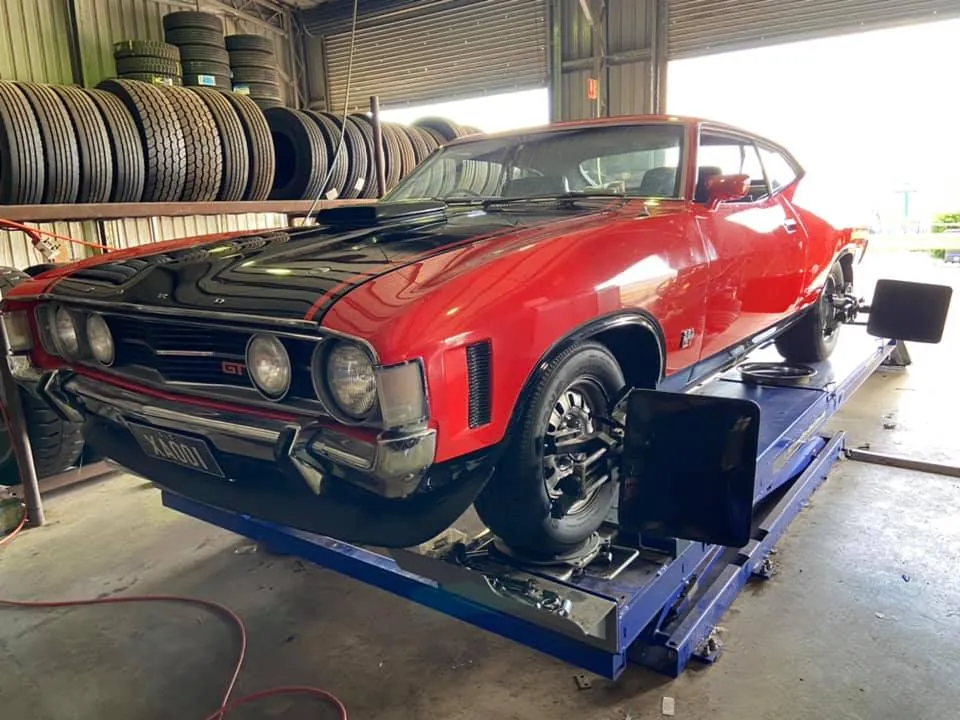
Our computerised alignment measures every one of those angles and shows them against the factory specification, in the red or in the green. You get the before and the after. That is the honest part. You can see for yourself that the wheels were out and that we brought them back to spec, rather than taking our word that something invisible got fixed.
Book it before it costs you a tyre
Alignment is small money next to a tyre, and next to the safety of a car that tracks straight and stops evenly. If yours is pulling, the wheel is crooked, or you have just noticed a tyre wearing on one edge, book it in. We will straighten it, hand you the printout, and while it is on the rack we can flag anything in the suspension or steering that is pushing it out of line.
Written from the workshop at 78 Carrington Road, Torrington. General advice only. For a straight answer on your own vehicle, give us a call or drop in.
All advice & guides